
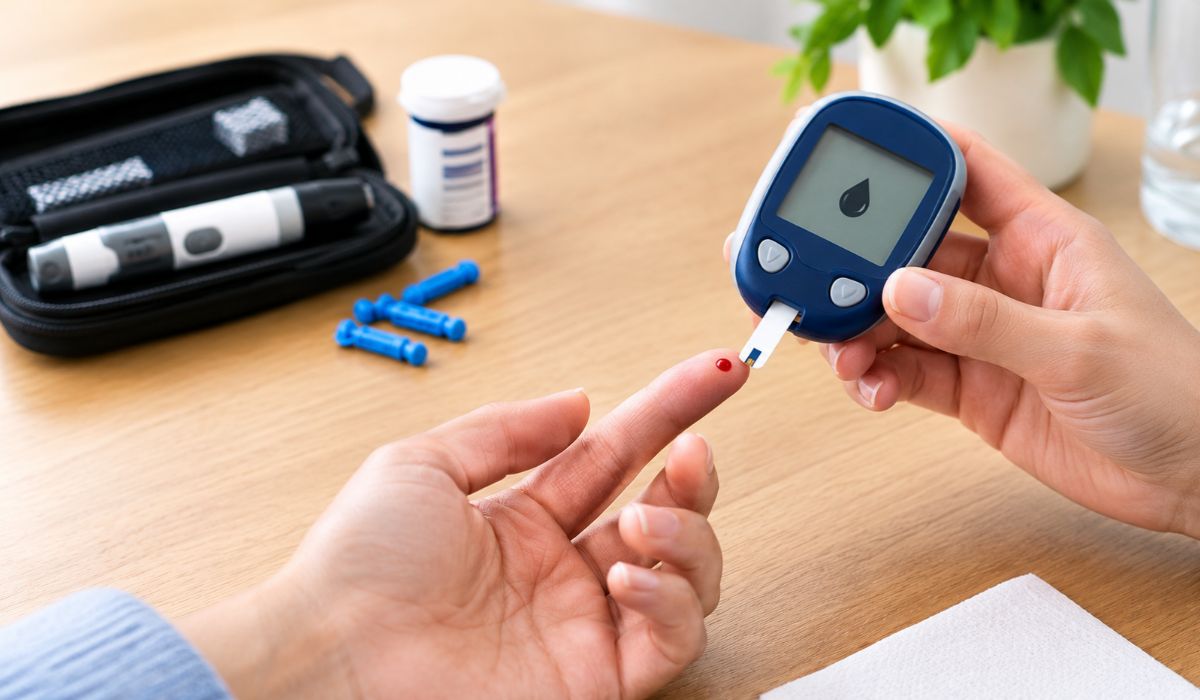
Checking your blood sugar with a quick prick of the fingertip is one of the most common health tests in the world. For people with diabetes, it is a daily routine. For others, it can be a useful way to understand how the body handles glucose. This guide covers how the test works, how to do it correctly, what the numbers mean, and where its limits lie.
What Is a Finger Stick Blood Sugar Test?
A finger stick blood sugar test, also known as capillary blood glucose testing or self-monitoring of blood glucose (SMBG), measures blood sugar levels using a small drop of blood collected from the fingertip. Glucose provides the body with energy, and its levels can change throughout the day due to food intake, physical activity, stress, illness, and medications.
The test uses three simple tools: a lancing device (a small spring-loaded pricker), a test strip, and a glucose meter. The meter reads the blood on the strip and displays the result, usually within five to ten seconds.
Who Needs This Test?
The test is most often used by:
- People with type 1 diabetes, who usually need to test several times a day
- People with type 2 diabetes, especially those using insulin or certain oral medications
- People with gestational diabetes during pregnancy
- People with prediabetes, when advised by a doctor
- Anyone experiencing symptoms of high or low blood sugar, such as extreme thirst, frequent urination, shakiness, sweating, or confusion
Your doctor or diabetes educator will tell you how often to test based on your condition and treatment.
Benefits of Finger Stick Testing
- Immediate results. You see your glucose level in seconds, which helps you act quickly if it is too high or too low.
- Better daily management. Readings show how meals, exercise, stress, and sleep affect your blood sugar, so you can adjust habits and, with medical guidance, medication or insulin doses.
- Early detection of dangerous lows and highs. Hypoglycemia (low blood sugar) can cause fainting or seizures if untreated, and persistent hyperglycemia (high blood sugar) can lead to long-term complications. Regular testing helps you catch both early.
- Affordable and accessible. Meters and strips are widely available, portable, and generally cheaper than continuous monitoring systems.
- Useful for your care team. A log of your readings helps your doctor fine-tune your treatment plan.
How to Perform a Finger Stick Blood Sugar Test: Step by Step
Always follow the instructions that come with your specific meter, since models vary. The general procedure is:
- Gather your supplies. You need your meter, a test strip, a lancing device with a fresh lancet, and a log or app to record results.
- Wash your hands with warm water and soap, then dry them thoroughly. Food residue, lotion, or moisture on the skin can give false readings. Warm water also improves blood flow to the fingertips.
- Insert a test strip into the meter and make sure the meter is on and ready.
- Prepare the lancing device. Insert a new lancet and set the depth. A shallower setting is usually enough and hurts less.
- Choose the puncture site. Use the sides of your fingertips rather than the pad, which has more nerve endings. Rotate fingers and sites each time to prevent soreness and calluses.
- Prick your finger. Press the device against the side of the fingertip and press the release button.
- Collect the blood. Gently squeeze or massage the finger to form a small drop. Avoid squeezing too hard, as this can dilute the sample with tissue fluid. Touch the edge of the test strip to the drop so it absorbs the blood.
- Read the result. Wait for the meter to display your glucose level, then record it along with the time and any relevant details, such as whether you had just eaten or exercised.
- Dispose of supplies safely. Place used lancets in a sharps container or a sturdy, puncture-proof container. Never reuse or share lancets or lancing devices.
Understanding Your Results
Blood sugar is measured in milligrams per deciliter (mg/dL) in many countries, including the US, and in millimoles per liter (mmol/L) in others, including India and the UK.
For people without diabetes (general reference):
- Fasting: about 70 to 99 mg/dL (3.9 to 5.5 mmol/L)
- Two hours after eating: usually below 140 mg/dL (7.8 mmol/L)
Common targets for adults with diabetes (the American Diabetes Association’s general guidance):
- Before meals: 80 to 130 mg/dL (4.4 to 7.2 mmol/L)
- One to two hours after the start of a meal: below 180 mg/dL (10.0 mmol/L)
Low blood sugar: A reading below 70 mg/dL (3.9 mmol/L) is generally considered low and should be treated promptly with fast-acting carbohydrates, such as glucose tablets or fruit juice, as advised by your doctor.
High blood sugar: Readings that stay well above your target need attention. Very high readings, especially with nausea, vomiting, or abdominal pain, need urgent medical care.
These ranges are general. Your personal targets may differ depending on your age, health conditions, pregnancy, and treatment, so confirm them with your healthcare provider.
Tips for Accurate Readings
- Check that your test strips are not expired and have been stored as directed, away from heat and humidity.
- Make sure the meter’s code or settings match the strip batch, if your model requires it.
- Never use a bloody or damaged strip.
- Use a control solution periodically to check that your meter is working properly.
- Keep your meter within its recommended temperature range.
- Do not test right after handling sugary foods or fruit without washing your hands.
Limitations to Keep in Mind
Home meters are accurate enough for daily management but are not perfect. Results can vary somewhat from laboratory tests, and certain conditions, such as dehydration, very low blood flow, or high altitude, can affect accuracy. Finger stick testing also shows only a single moment in time. It does not capture overnight trends or the sudden spikes and dips between readings. That is why doctors also use the HbA1c test, which reflects your average blood sugar over about three months, and why some people use continuous glucose monitors (CGMs) alongside or instead of finger sticks.
Finger stick results also cannot diagnose diabetes on their own. Diagnosis requires laboratory testing ordered by a doctor.
Reducing Pain and Discomfort
Most people find the prick mild, but a few habits help:
- Use the sides of the fingertips, not the center.
- Choose the shallowest depth setting that gives enough blood.
- Change the lancet regularly, since dull lancets hurt more.
- Rotate fingers to give each site time to heal.
- Keep your hands warm before testing.
When to Contact Your Doctor
Reach out to your healthcare provider if you have repeated readings outside your target range, frequent low readings, symptoms that do not match your readings, or signs of infection at the puncture site, such as redness, swelling, or persistent pain. Seek emergency help for confusion, fainting, seizures, or very high readings with vomiting or difficulty breathing.
If you are looking for Finger Stick Blood Sugar Test, we provide reliable testing services to help you monitor your blood sugar levels and support better diabetes management. Our goal is to make glucose testing convenient, accurate, and comfortable for your health needs.
Final Thoughts
The finger stick blood sugar test is simple, fast, and powerful. With proper technique and consistent record keeping, it gives you real-time feedback about how your body responds to daily life and helps you and your care team make smarter decisions. If you are unsure how often to test or what your numbers mean, ask your doctor or diabetes educator. This article is for general information and is not a substitute for personal medical advice.
FAQs
Is the finger stick blood sugar test painful?
Most people feel only a brief pinch. Using the side of the fingertip, a shallow depth setting, and a fresh lancet reduces discomfort.
How often should I check my blood sugar?
It depends on your condition and treatment. People on insulin may test several times a day, while others may test less often. Follow your doctor’s advice.
What is a normal blood sugar level on a finger stick test?
For people without diabetes, a fasting level is typically 70 to 99 mg/dL (3.9 to 5.5 mmol/L). Targets for people with diabetes differ and should be set by their doctor.
Can I use the same lancet more than once?
It is not recommended. Reusing lancets makes them dull, increases pain, and raises the risk of infection. Never share lancets or lancing devices with anyone.
Why is my reading different from my lab test result?
Home meters can differ from lab results by a margin, often up to about 15 percent. Differences in sample type, timing, and meter technique also play a part.
Can I test my blood sugar at home to diagnose diabetes?
No. A home meter is a monitoring tool, not a diagnostic one. Diagnosis requires lab tests such as fasting plasma glucose, HbA1c, or an oral glucose tolerance test.
Can I test on places other than my fingertip?
Some meters allow alternate sites like the palm or forearm, but these can lag behind actual glucose changes, especially after meals or during low blood sugar. Fingertip testing is more reliable in those moments.
What should I do if my reading is very low?
If it is below 70 mg/dL (3.9 mmol/L), take 15 grams of fast-acting carbohydrate, such as glucose tablets or half a cup of juice, recheck in 15 minutes, and repeat if needed. Contact your doctor if lows happen often.
Do I need to fast before testing?
Only for fasting readings. Many tests, such as before-meal or after-meal checks, are timed around eating, so follow the schedule your doctor gives you.
How should I store my test strips and meter?
Keep strips in their original container, tightly closed, at room temperature, away from moisture, heat, and sunlight. Do not use expired strips.